
This is more than something that goes bump in the night. This is riding around in the mind of a serial killer—or the person running from one. True crime meets horrifically thrilling fiction.
The Dark Passenger & the Warren Museum
Dexter calls it his Dark Passenger. I think of it as a little seed of darkness, something fiction lets me turn over and examine. What does a character do with it? How far will they go, and what will they tell themselves afterward?
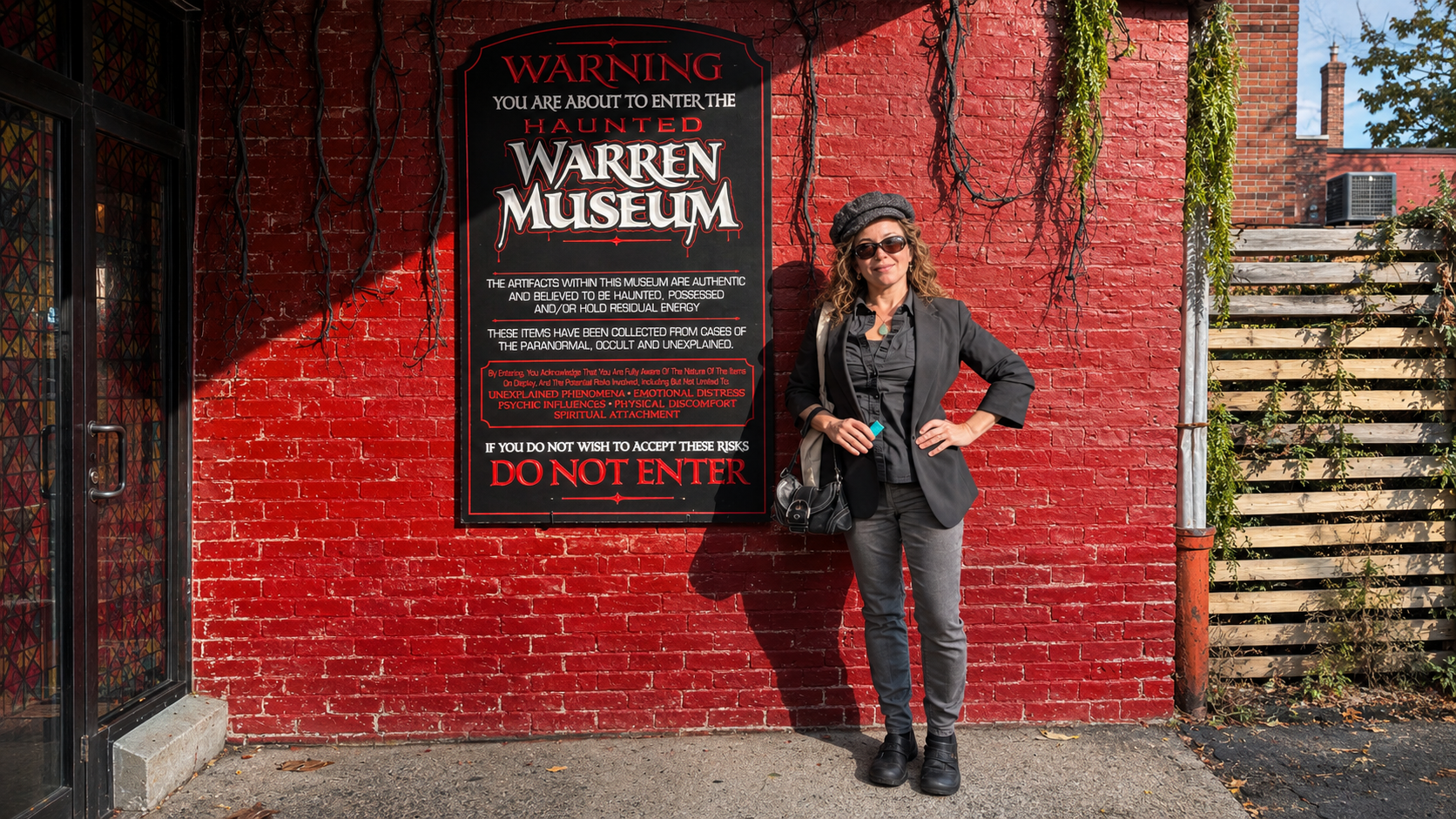
Last month I took a little trip to the Haunted Warren Museum at 259 Essex Street in Salem, Massachusetts. It’s a limited-run exhibition of more than a thousand paranormal relics and true-crime items—serial killers’ belongings alongside haunted dolls like the real Annabelle—with tickets ranging from flashlight tours to VIP and paranormal investigation packages. I went with the $60 flashlight tour. (Filming wasn’t allowed, so the visuals you see here come from elsewhere.)
I was in and out in less than half an hour. Being in there, I went from claustrophobic to nauseous. I had paid all that money to help memorialize killers.
My reaction was to focus on the victims. I’ll get to them in a minute. But first, let’s take a deeper look at Dexter, the notorious fictional antihero who kills villains.
Dexter and the Feedback Loop
The line between true crime and fiction blurs from both directions. True-crime writers borrow the techniques of novelists. Worse, sensational media coverage can create a feedback loop in which real criminals model their identities, or their methods, on famous fictional archetypes.
Jeff Lindsay’s 2004 novel Darkly Dreaming Dexter and the Showtime series starring Michael C. Hall are a textbook case of both. The franchise didn’t just absorb the real world into its fiction. It bled back out into reality.
From a Luncheon to Forensic Realism
Jeff Lindsay didn’t set out to write true crime. He told NBC Miami the idea came to him while giving a talk at a Kiwanis Club luncheon. Looking out over a room of “real estate agents, insurance agents and other assorted shills and hucksters,” he recalled, “the idea popped in my head from nowhere that serial murder is not always a bad thing.”
To ground that pitch-black concept, the books and the show leaned on real-world detail:
- The forensic mask. Dexter isn’t a supernatural entity or a chaotic, disorganized monster. He’s a blood-spatter analyst for Miami Metro Police, and the story anchors him in meticulous, clinical forensic science borrowed from real procedure.
- Real-life parallels. Life supplied its own echoes. Brazil’s Pedro Rodrigues Filho, who claimed to target other criminals, was later nicknamed the “Brazilian Dexter.”
When Fiction Becomes a Blueprint
The dark side of this blending is that Dexter’s logical, forensic, highly organized “Code” became a blueprint for real copycats, who modeled their identities, aesthetic choices, and methods on Dexter Morgan.
- 2008, Edmonton, Alberta. Filmmaker Mark Twitchell rented a garage and recreated Dexter’s plastic-sheeted kill room. He lured Johnny Altinger there through a fake online dating profile, murdered him, and wrote about it in a laptop document titled “SK Confessions.” Twitchell was convicted of first-degree murder in 2011.
- 2026, the West Midlands, England. Benjamin Day, a 20-year-old forensics student obsessed with the show, lined a rented Airbnb with plastic sheeting and murdered 24-year-old Maria Saceanu. He was arrested wearing a Dexter-style khaki top. In October he pleaded guilty to murder; his sentencing is set for December 4.
The loop closes here. Real forensic protocols inspired a fictional “hero.” The fiction stylized and romanticized murder. Real killers then consumed that fiction as an instruction manual, and true crime had to document them all over again.
And yet Dexter remains iconic. That’s the uncomfortable part: on the page, it’s hard not to love him. Spending time in a killer’s head means listening to the way he makes killing sound reasonable—and his dark humor makes it a strange place to find yourself entertained.
The Housemaid — Freida McFadden
Like Dexter, Millie tells her own story, and she brings the reader uncomfortably close.
Millie needs the job the Winchesters offer her. She has a criminal record, few options, and good reasons to put up with more than she should. Inside their home, keeping the peace becomes increasingly difficult. Beside Dexter’s account of himself, it makes an uneasy pairing: Millie has to read other people’s behavior while depending on them for a roof over her head.
Spoiler alert: this victim turns the tables, which makes her an antihero, too—another killer of villains.
Tropes Over True Crime
Where Dexter blended real forensic profiling and killers’ methods into its story, The Housemaid borrows from other thrillers. Its beats will feel familiar to readers of domestic suspense like The Last Mrs. Parrish: an attic bedroom door that locks only from the outside, elaborate gaslighting schemes. It plays out as a high-drama popcorn thriller, not a forensic guide. It centers on survival, domestic abuse, and sudden defensive retaliation, with no systematic method or romanticized killer identity for a copycat to latch onto. Dexter invited the real world in. The Housemaid stays a sealed, fictional thrill ride.
McFadden kept her own double life just as contained. In April 2026, after years behind the pen name, she revealed that she is Dr. Sara Cohen, a physician who treats brain disorders. For more than a decade she kept her medical career and her writing identity strictly separate.
Some readers find her twists a little too familiar. To my mind, that’s beside the point: she sets out to deliver extremely well-constructed entertainment, and she does it with a high degree of professionalism. If being prolific is a crime, then I’m guilty too—I just haven’t published yet. Writing as a second career gives a person time to create worlds and refine them. And when a woman is as smart and savvy as Virginia Woolf and makes a room of her own, on her own terms, there’s certainly room for prolific storytelling. It just happens.
Beyond the Killers: The Survivors
Deadly intention is frightening enough. Being allowed to hear the reasoning behind it can be worse—or better, depending on what kind of media you consume. And then there are the people trying to survive, who don’t get to read the next chapter and find out who they should have been afraid of.
Exploring the dark, abnormal psychology the human mind is capable of is one of those things most safely done as a reader. Writing it is a whole new level.
Bright Young Women — Jessica Knoll
In 1978, Pamela Schumacher survives an attack on her sorority house. Tina Cannon believes the same man is responsible for the disappearance of Ruth, the woman she loved. Their search for answers brings them together.
Inspired by Ted Bundy’s crimes, Knoll’s novel never names him. Instead, it gives the women whose lives the violence changed the attention usually lavished on the killer: their grief, their relationships, their pursuit of justice. In a genre so often fascinated by the man behind the violence, that’s a welcome shift, and it belongs in any conversation about our fascination with killers.
The Crying Killer — Jess Lourey
This one arrived in August. Tuesday Hendrickson has spent eight years trying to build a life after her sister’s murder. The killer was believed dead. Now Tuesday thinks she has seen him in Saint Paul.
She’s a private investigator with a daughter to protect, and the possibility that he’s alive reaches straight into the life she has made. Lourey draws on true crime and brings a personal stake to familiar serial-killer territory: a survivor protecting the life she rebuilt when the danger she thought was buried appears to return.
When the Book Is Closed
The door can be locked, the house quiet, and a story can still get under your skin. We’ve spent hours listening to someone justify a murder, or watching another person try to survive one. Whose head would you rather ride around in: the killer’s or the survivor’s? Tell me which book put you there.
Now that we’ve crossed the threshold into the dark half of the year, we’ll pivot from the mundane to the morbid and keep investigating the darker side of the human soul. Stay tuned for a deeper dive in next week’s episode: Anatomy of a Wolf.
I’m always pulled toward the newest adventure, the next cycle. I don’t like regurgitating old processes over and over—writing, editing, or reading the same tripe. I want it raw and real. Don’t you?
If you’d like more from the Night Scribe, subscribe below. It arrives in your inbox regularly with new publications.
So come in from the cold, sit back, and enjoy the reel.
Leave a Reply