
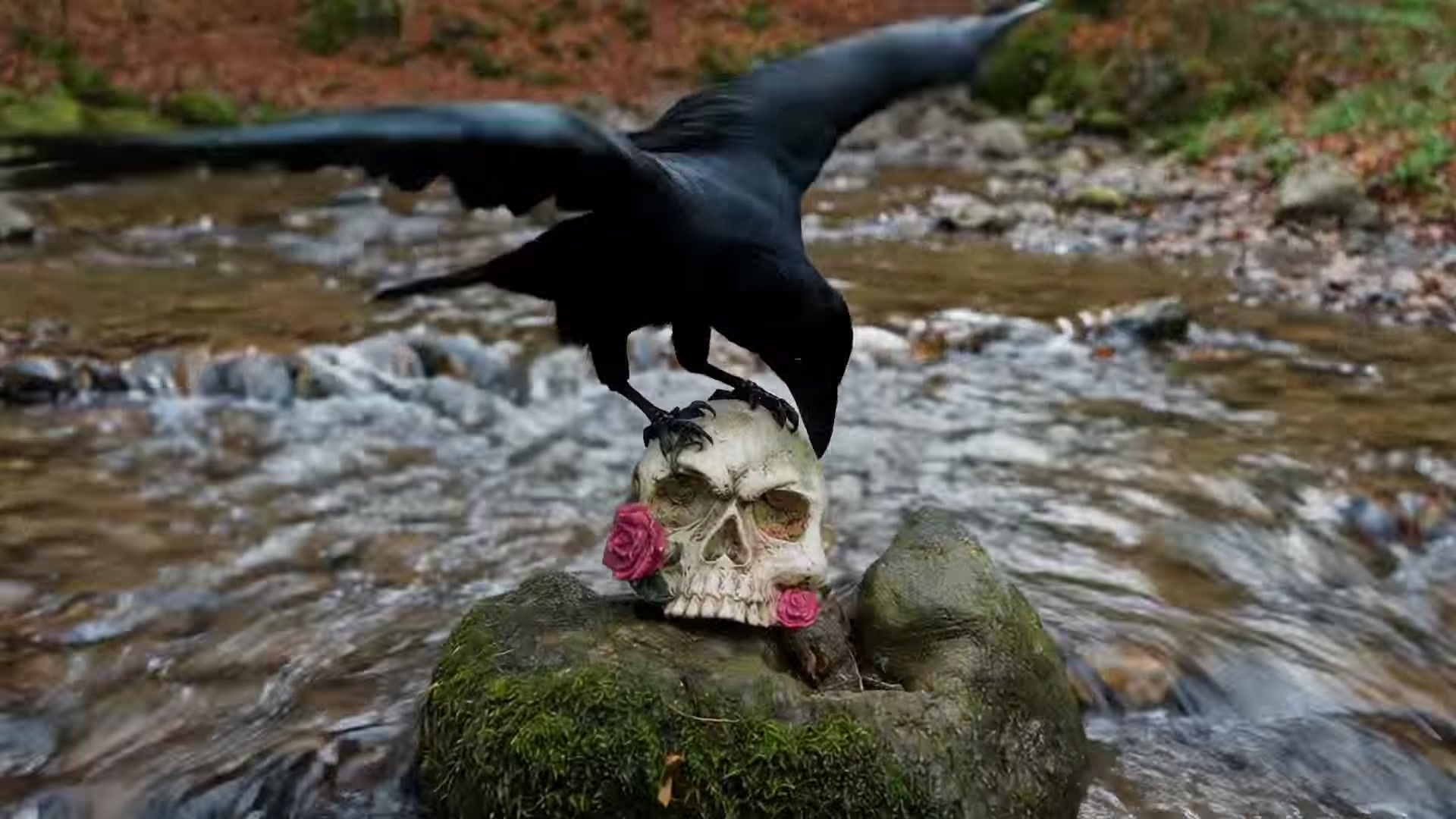
The dead have a way of staying near. A recipe, a coat still on its hook, a song that comes on in the car. Sometimes a place feels occupied long after whoever lived there is gone.
With Día de los Muertos here, I’ve been thinking about that nearness. The Mexican tradition welcomes the dead home with offerings and remembrance. It shares these early November days with All Saints’ Day and All Souls’ Day, though each has its own history. There are so many ways of keeping company with the dead.
I found myself writing from the other side of that company in my writers’ group this week. A little something for the restless ones who never quite leave:
Here & There
I lived. Here, the worms skitter between my ribcage and spinal cord. There, it was warm and light even in the dark of night. Food appeared in its place. If it didn’t, I knew whose bedside to warm. Or in whose ears to caterwaul until things got made right. Jumping between porch rails and dried broken vines, the trail between the swirling waters and the home fires grew longer and harder to traverse. Trees got taller, gardens grew thick with weeds. Eventually I found myself here in the damp earth. I’m hoping my spirit goes before the winter snows, but the light still shines from the hearth where I lived.
That last light is where I want to linger. There’s a home within sight, and a creature still trying to leave. I can follow that feeling into a ghost story, or into a book with no ghosts at all.
What do we mean by a soul?
What happens to a soul when someone dies can start an argument as quickly as religion or politics. Fiction gives us room to wonder. We can pretend a soul has weight, that someone can steal it, or that a person can get along perfectly well without one. Then we have to live with the consequences for a few hundred pages.
Vampires, witches, and creatures caught somewhere between the living and the dead make good company for these questions. So do ordinary people trying to work out where they belong. These three books take me in very different directions.
Soulless — Gail Carriger
Alexia Tarabotti has no soul. In Carriger’s supernatural Victorian London, that comes with a useful complication: her touch cancels supernatural powers. An encounter with a vampire draws her into a mystery involving London’s vampires and werewolves, with Lord Maccon investigating and social etiquette getting in the way.
“Soulless” is usually an accusation. In this book, the condition pairs Alexia’s logic with Lord Maccon’s beastly passion, perfectly embodying dark gothic romance amidst steampunk machinery and mystical aristocrats. Having no soul strips away supernatural grace, grounding her in absolute mortality.
On this day honoring the dead, her condition reminds us that life is defined by our internal spark; without it, we walk between existence and the permanent quiet of the grave.
Secondhand Souls — Christopher Moore
With Christopher Moore, I expect his raunchy brand of humor to follow us into the afterlife—with a little killing on the side, for fun. Secondhand Souls returns to the San Francisco of A Dirty Job, where the work of collecting souls has gone badly wrong and souls are disappearing.
Giving souls somewhere to go means someone has to mind them on the way. Leave that job to Moore’s characters and there’s going to be trouble. Sometimes a little levity on a serious subject opens doors to let emotions pass more easily. After all, we all cross the river. Comedy defangs the terrifying finality of death. By replacing solemn mourning with absurd supernatural antics, his humor allows readers to put it in perspective.
The Feast of All Saints — Anne Rice
All Saints’ Day brings Anne Rice’s title to mind, and with it New Orleans—a city with more than enough history to keep my imagination occupied, where it’s easy to feel the veil of our connection to the world beyond the living slip. The connection to Día de los Muertos is one I’m making here; the novel tells a different story.
The Feast of All Saints follows free people of color in the 1840s, living within a society that sharply limits their choices. In New Orleans, social upheaval blurs the boundaries of life and death. The raw ache of forbidden plaçage entanglements and the ghosts in The Feast of All Saints brought love tears, while the cold, stone tombs of the crescent city and its evocative ambiance left me both thrilled and chilled to the bone.
The light still shines
A character doesn’t need to be good to have a soul. I’m obsessed with what happens when affection and selfishness live in the same person, when someone causes harm and still has someone waiting for them at home. There’s plenty to haunt a reader in the grey matter between the living eardrums and eyeballs. When the seasonal darkness draws us toward preternatural considerations of what lies beyond the grave, the results of these stories evoke a heightened emotion. Light and shadow play tricks on me. Maybe it just depends on which wolf you feed?
As the nights get longer and the days get shorter, I dive deep into the page, alongside the pets, a roaring fire, and a cup of warm tea. I keep coming back to that imprint in my mind, of a small creature in the earth, looking toward the hearth. The light is still there. Leaving is the hard part.
Which fictional soul has stayed with you long after the last page? I’d love to know whose story you’re still carrying.
The Night Scribe arrives regularly with more stories and reading company. Subscribe at anyamaribooks.substack.com. Come in from the cold.
Next: Thrill of the Kill: True Crime Meets Horror Fiction.
Leave a Reply