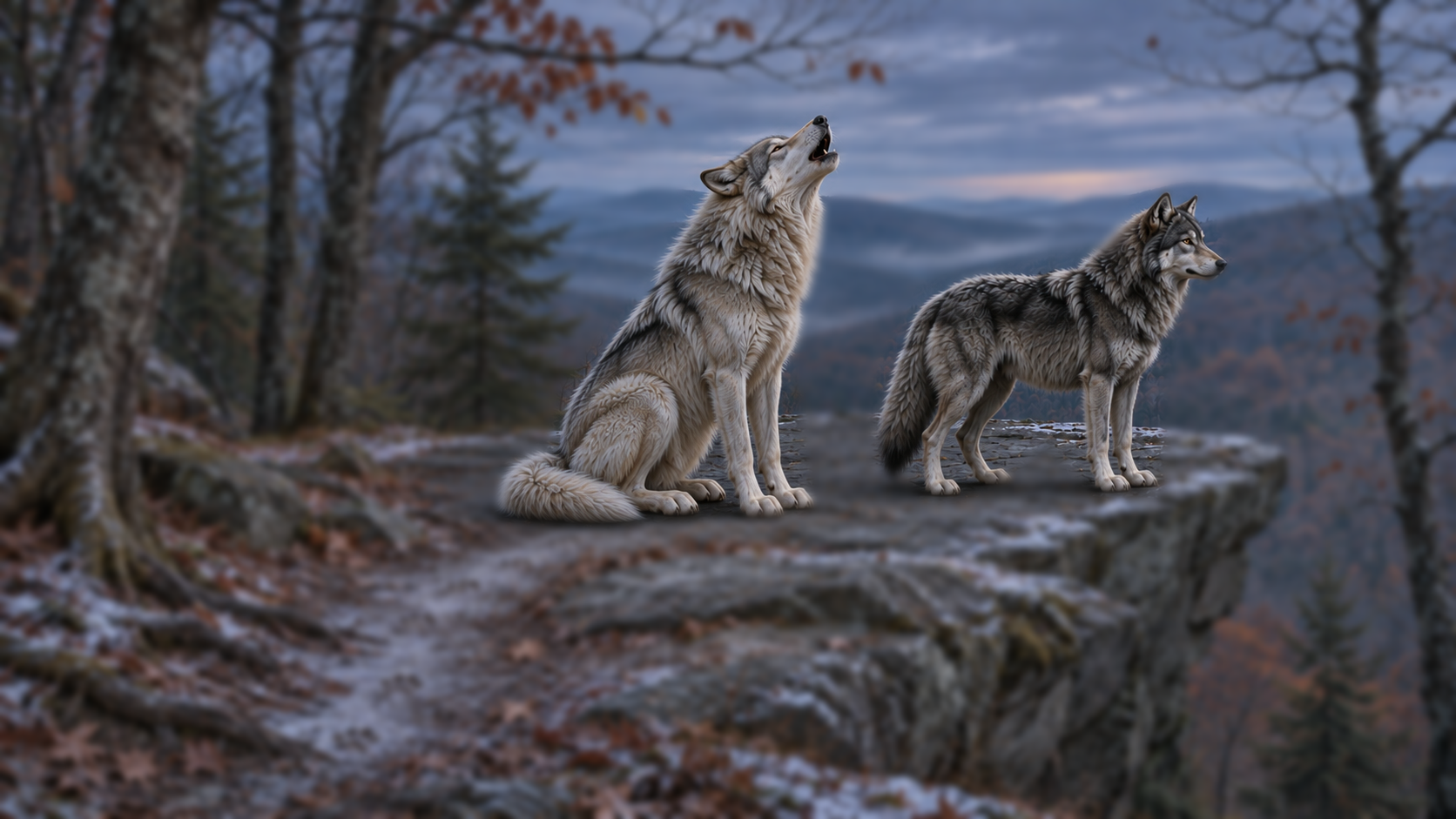
The tension between wild freedom and pack loyalty is the core paradox of the wolf archetype across human history. Rather than opposing its independence, the wolf’s devotion to its circle makes that independence meaningful.
Wolf archetypes are constantly changing, but the call of the wild and the desire for freedom reign supreme with me. Within the wolf’s circle, domestic loyalty gives freedom more importance, not less. You must break from society’s expectations and conformity to discover your inner strength. All cultures have a version of this.
Wild freedom. Fierce devotion.
What blows my mind? The alpha wolf is not even real.
Not “scientists disagree.” Simply, it doesn’t exist. The idea came out of a debunked mid-twentieth-century study of captive wolves. Unrelated adults penned together, strangers forced into a yard, behaving the way strangers behave like Lord of the Flies when they cannot leave. Shocker. A dominance hierarchy formed, the way it forms in a prison. Researchers wrote it down and called it wolf nature. A classic misunderstanding based on treating animals as if they’re not sentient beings.
L. David Mech put the word “alpha” into wide circulation with his 1970 book, and then spent decades taking it back. His long study of a wild pack on Ellesmere Island found something much less cinematic: a breeding pair and their offspring from the past two or three years. A family. The young leave at two or three to find mates of their own. Infighting is rare. Calling the breeding male an alpha, Mech has said, is like calling a human father the alpha male. He is just the dad.
He has since asked his publisher to stop printing that 1970 book.
In 1992 Clarissa Pinkola Estés published Women Who Run With the Wolves, and the archetype turned again, but this time inward. Her wolf is the instinct that hasn’t been domesticated: accurate intuition, boundaries held without apology, fierce devotion to your people while remaining entirely yourself.
That last part is the dichotomous task we all must learn to survive the lives we lead, and it is the reason the wolf keeps working as a character engine. Belonging and freedom pull against each other. A pack costs you something. Independence costs you something else. Every wolf story is really an argument about which price the character is willing to pay.
So, why do we crave the Alpha versus Omega story?
Because the family is not a story and the hierarchy is.
A pack with ranks gives you conflict, stakes, a ladder to climb and a throne to be knocked off. It gives you an alpha with the weight of everyone’s safety on his back, and an omega at the bottom who is either a victim or a rebel depending on who is telling it. That is a plot. Parents raising pups until they leave home is a life.
At its core, the Alpha and Omega duality is just a mirror for the constant tug-of-war happening inside all of us. On one side, we have the Alpha urge to push forward, build things, and take charge, while on the other, the Omega calls us to slow down, feel deeply, and simply let things unfold. When we get stuck living in only one of these modes, we end up feeling strangely incomplete—either exhausted from fighting every current or adrift without a compass. That quiet ache is our craving for cosmic wholeness, balance, a desire to weave our boldest beginnings together with our deepest stillness until we feel entirely at home in the universe. But the reality is a lot more complicated.
Maverick wolf: outrider with an untamed heart
Before the wolf was a found family, it was a sentinel.
The lone wolf invites readers to explore their rebel side. Take the teenager who did not fit—too strange, too quiet, too much. The lone wolf reframes that. It turns exclusion into election. You were not rejected; you were never meant for the pack in the first place. That is a powerful thing to hand a fifteen-year-old, and it is why the trope refuses to die no matter how many biologists explain it.
In early Germanic law the same word covered wolf and outlaw. To be named one was to be stripped of protection and put outside the walls, where anyone could kill you without consequence. The lone wolf was not a particular creature anomaly, so much as a status: you are no longer ours.
Norse myth took it further. Fenrir, Loki’s monstrous son, waits in his chains to devour Odin at Ragnarök. The sky-wolves Sköll and Hati run after the sun and the moon and will one day catch them. Odin himself keeps two wolves, Geri and Freki, whose names mean roughly the ravenous and the greedy—the battlefield’s appetite, sitting at the feet of the god.
That is the wolf as devourer: hunger that eventually eats the light. The root of the question, “which wolf do you feed?”
Primal wolf: the one who nursed Rome
And then, from the same era of human imagination, the exact opposite.
Lupa, the she-wolf, found two abandoned infants and fed them, and in doing so founded a city. Rome’s origin story asks us to believe that the empire’s ferocity came from her milk—that being raised by a predator is what made the founders strong.
Same animal. One tradition makes it the end of the world; another makes it the beginning of a civilization. The wolf has never had a fixed meaning. It has only ever had a job: to carry whatever we cannot say plainly about appetite, loyalty, and who belongs.
The wild self in a gilded cage: Four books, a dichotomy of wolf personae
A few novels on my shelf pull on different aspects of the wolf persona, and none of them needs a full moon.
The Wolf Den — Elodie Harper
Amara was a doctor’s daughter in Greece before poverty and enslavement brought her to a brothel in Pompeii. Her intelligence has not disappeared because the world has decided what she is worth. Among the other women, she finds friendship, shared hopes, and moments of relief inside a life controlled by someone else.
Here the pack is a way to survive. Sisterhood offers shelter, but freedom has a price, and wanting a way out can strain the bonds that make endurance possible. The wolf image turns toward women whom society exploits and then judges for the conditions it has forced upon them.
In The Wolf Den, Elodie Harper gives us women who have every reason to bare their teeth. Amara has her wits, and the women around her have each other—sometimes that is all they have. But wanting freedom and finding a way to claim it are very different things. What happens when the way out puts the people who helped you survive at risk?
Wolf on a String — Benjamin Black
Benjamin Black, John Banville’s crime-writing name, takes us to Prague and the court of Rudolf II. A young scholar, Christian Stern, encounters a murdered woman and is drawn into a world of court intrigue. Curiosity brings him closer to power, but power doesn’t guarantee safety.
This is the wolf in human company: watchful, calculating, difficult to identify until you are already within reach. Beside Harper’s women finding strength together, this court offers a different kind of enclosure. Being admitted does not mean belonging. Be careful of flying too close to the flame. Trust no one.
Prague feels right for this story. It is a city with a long history of fighting for freedom, from the Hussite Wars to the Velvet Revolution. But in Rudolf II’s court, you learn to watch what you say and who might be listening. I love the contrast: all that velvet and alchemy, and underneath it, the fear of being yourself.
For the Wolf — Hannah Whitten
Red is the second daughter, intended as a sacrifice to the Wolf in the Wilderwood. She goes carrying a dangerous power of her own. The legend has prepared her for a monster, but the Wolf is a man, and the forest holds dangers her upbringing has not taught her to understand.
Societies often build mental cages through fear-driven myths, labeling untamed power “monstrous” to enforce conformity. Like Red leaving civilization to claim her magic and chosen loyalty, readers embrace books about antiheroes and villains as a quiet rebellion against rigid norms. These “monsters” shapeshift in our minds—evolving from frightening threats into relatable mirrors of our own suppressed strength, reminding us that breaking the rules is sometimes how we finally become ourselves.
The question changes as the person behind the name comes into view. Who benefits when someone is called a monster? What happens when fear gives way to understanding—and then desire? Here, the beast breaks past the confines of the legend to become the beloved.
The first three novels offer different pressures: surviving together, navigating predatory power, and discovering who lives behind a frightening name. None needs a literal wolf pack to ask who belongs, who hunts, and who gets called dangerous. Across all three books, the wolf evolves: in The Wolf Den, the pack helps you endure a cage; in Wolf on a String, society puts the wolf on a leash; and in For the Wolf, stepping into the wild reveals that the “monster” was never the wolf—it was the society demanding your conformity.
Darkly Dreaming Dexter: Predator with a code
We explored his killer instinct in Thrill of the Kill, but Dexter embodies the vigilante justice of the lone wolf better than most antiheroes. Dexter brings the philosophical question of “which wolf do we feed?” into contemporary crime fiction. A killer who targets other killers, he channels his appetite through a code and hides it inside an apparently ordinary life. We are invited to follow the hunter because we know what his targets have done.
That makes him useful here as a human version of the predator we want to believe we can understand. His code offers a boundary; it does not make him harmless. Is he mastering his nature, finding an outlet for it, or giving himself permission? The discomfort is part of why we keep watching.
Dexter has Harry’s Code to keep his teeth away from the wrong throats. Mostly. We know what he is, yet we find ourselves hoping he gets away with it. His victims have done terrible things, and that makes it easier to excuse what he does to them. I’m always curious about that moment when I start making exceptions for someone I would be terrified to meet.
What the wolf teaches about building characters
Strip the fur off and you have a pressure system any character can be dropped into.
- A group that offers safety at the cost of privacy
- A hierarchy that may be fictional but, believed in, is real enough to hurt
- An exile who has reframed being cast out as having chosen to leave
- An instinct the character can neither remove nor fully trust
- A vigilante constantly battling inner demons
None of that requires a full moon. It is high school. It is a family. It is any workplace you have ever chosen to sever connection with. It’s the life you choose to keep, or end.
Primal instinct. Chosen loyalty.
The wolf we invented was ranked, dominant, fighting for the top. This says more about human drives than about any animal in a forest. The real one turns out to be a parent with a couple of yearlings trailing behind, teaching them to hunt before they go.
And then they go out into the wilderness, on their own quest for survival. And a mate. They must follow or build their own code. Find a family to join, a society, or start one. The decision about how much conformity a soul craves varies from one being to the next. So too the decision of how big is our circle, how strong our allegiance.
A tender heart with sharp teeth. It was never a contradiction. That is just what it costs to protect something.
Imprinting: when the wolf falls in love
There is one more wolf, and it is the one romance readers argue about at midnight.
Twilight’s supernatural imprinting takes the fantasy of an absolute bond and turns it into fate. The bond chooses before the character can, shaping what that person becomes to the other: protector, companion, or eventually a partner. This is a fictional mechanism, not the way real wolves form attachments, and it is separate from the developing romance in For the Wolf. Some readers find that certainty deeply romantic. Others find the loss of choice unsettling. The tension belongs here.
Because devotion to another makes us vulnerable, that absolute is never only tender. A love that would do anything to protect you is a love that would do anything. Somewhere in that sentence, the heart and the teeth stop being opposites and start being the same thing.
That is where we go next: the place where desire and death sit down at the same table.
Next: Eros & Thanatos—the dark side of love.
If you’d like more from the Night Scribe, subscribe below. It arrives in your inbox regularly with new publications.
So come in from the cold, sit back, and enjoy the reel.
Sources
L. David Mech on the alpha wolf, captive vs. wild packs, and the Ellesmere Island study: Scientific American, “Is the Alpha Wolf Idea a Myth?” — scientificamerican.com
Elodie Harper, The Wolf Den: hachettebookgroup.com
Benjamin Black, Wolf on a String: macmillan.com
Hannah Whitten, For the Wolf: hachettebookgroup.com
Dexter and the Code of Harry: paramountplus.com
Leave a Reply