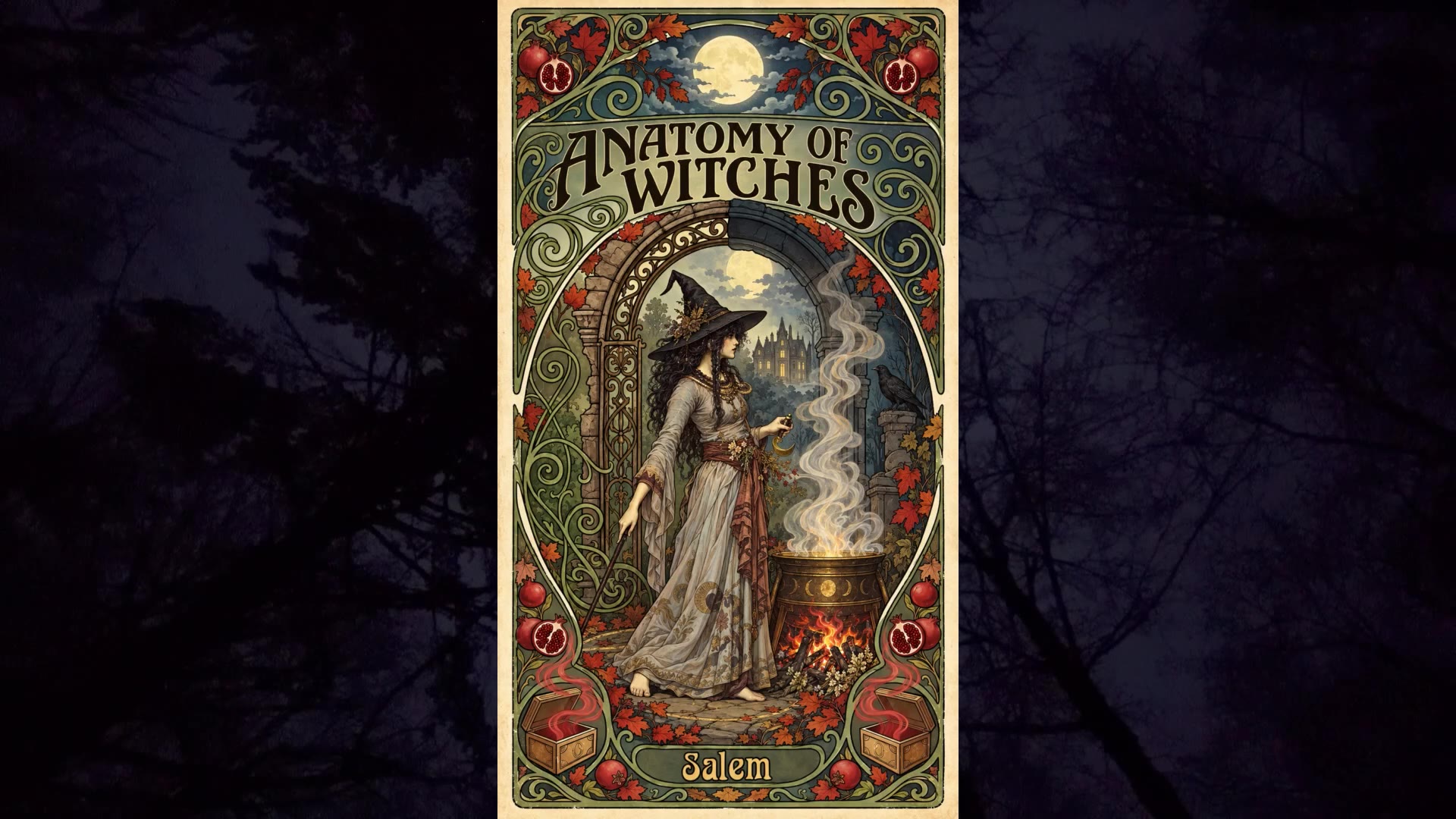
What happens when a heroine refuses to behave or fall in line with traditional expectations of her community?
Anya Mari—Character, story, and the beautiful trouble of being human
Every October, the season of Samhain invites reflection, and my deepest pondering of character analysis this year is fixated on the craft. Pagans and colonials alike called these healers and seers witches. As a writer, I’m fixated on the heroine’s journey and the anti-hero character analysis.
At Halloween, witches turn up on book covers and in shop windows, on television, and in costume aisles, in stories about women who live at the edge of town and know too much, want too much, love too fiercely, or simply will not stay inside the role someone else wrote for them.
This year they have company. The Owens sisters are back—Practical Magic 2 arrived in US cinemas on September 10, 2026, directed by Susanne Bier and drawn from The Book of Magic, Alice Hoffman’s final novel in the series, with Sandra Bullock and Nicole Kidman returning nearly three decades after the first film.
Which makes this a magical season to ask a question that has almost nothing to do with cauldrons:
Why do we keep making witches out of women?
And the better question underneath it: what happens when the witch is the heroine?
The heroine’s journey is not the hero’s journey in a dress
The familiar hero’s journey runs on departure, trials, confrontation, transformation and return. Maureen Murdock wrote The Heroine’s Journey partly in response to that model, arguing that a woman’s psychological journey in a culture built on masculine definitions of success could not simply be mapped onto it. Her version begins with separation from the feminine, moves through achievement on borrowed terms, and then descends—into a reckoning that has to happen before anything like wholeness is possible.
I don’t think every story about a woman has to follow that shape. I certainly don’t think every heroine needs to arrive at the last chapter healed and emblematic.
The opposite, really. The heroines worth reading are the ones who don’t resolve neatly. They want incompatible things. They have virtues that turn into liabilities and flaws that occasionally save them. And often the society around them is so invested in what a woman should be that the very qualities making her compelling become the evidence against her.
Which is where the witch comes in.
The witch has always been a problem of perspective
“Witch” has never been a neutral word. European witch-hunting intensified through the late medieval and early modern periods; tens of thousands of people were executed on accusations of witchcraft, and the overwhelming majority of the accused were women. Salem was one American episode in a much wider Atlantic history of fear, religious anxiety and local grievance.
The pointed hat and the broomstick came later. The Halloween witch is a costume assembled over centuries, not a portrait of anyone who actually stood trial.
But stories are very good at turning historical fear into metaphor, and the witch turned out to be an unusually useful one. She could stand for forbidden knowledge, or sexuality, or independence, or old age, or healing, or revenge, or the refusal to marry, or the simple terrifying possibility that a woman might know something nobody else could control.
That makes her close to a perfect subject for the heroine’s journey. Change the narrator, and the witch changes with it.
Three books on my desk this month make the point better than I can.
Myths and Magical…Realism
There’s an older argument hiding inside the witch, and it isn’t about spells.
Magic has long served as an allegory for intuition—specifically, for a way of knowing that doesn’t show its work. Intuition appears to skip the steps because it runs on fast, subconscious pattern recognition: a lifetime of noticed detail arriving as a conclusion before the reasoning catches up. The knowledge is real. The audit trail isn’t.
That’s a problem for systems built to verify. Empirical frameworks—historically male, now increasingly machine—have a structural blind spot where conclusions arrive without visible data points. Faced with a woman who was right and can’t say why, a system that cannot reverse-engineer her reasoning has three options: accept the conclusion, dismiss her, or reclassify what she did as something other than thinking.
Calling it supernatural is the third option. It’s a tidy move, because it does two jobs at once. It explains the unexplainable, and it removes her knowing from the category of legitimate knowledge, where it might have to be taken seriously.
Which is why “she’s a witch” and “she’s intuitive” and “she’s difficult” have always been closer to one another than they look. Each one answers the same inconvenience: a woman who knows something the available instruments can’t account for.
This is also, I think, why magical realism works as well as it does. It doesn’t ask whether the magic is real. It treats the unquantifiable as simply part of the furniture of life—which is much closer to how most people actually experience knowing things.
Quantum Mysticism
Now let me argue the other side, because I can hear it coming.
Fritjof Capra’s The Tao of Physics (1975) drew parallels between modern physics and Eastern philosophy, and the idea has been reaching for mysticism ever since. David Bohm used the hologram as an image of wholeness: cut a holographic plate into pieces and each piece still contains the whole image, only dimmer. It echoes Indra’s Net, that endless web of jewels in Hindu and Buddhist thought, each one reflecting all the others. Reality as relationship rather than as a collection of separate things.
It’s beautiful, and it is tempting to run it further—to say that physics has finally caught up with the intuitive, that consciousness and energy and healing are vindicated at the subatomic level.
But these are philosophical parallels, not proofs. Quantum mechanics does not explain intuition, and it certainly doesn’t validate anybody’s crystals.
Still, I notice that both the witch and the physicist are describing a world where everything is connected and the parts contain the whole.
But that’s a subject for another story.
Margarita: the witch who says yes
Mikhail Bulgakov wrote The Master and Margarita under Stalin, and it could not be published in his lifetime. The Devil arrives in Moscow with an entourage that includes an enormous talking black cat, and proceeds to take the literary establishment apart.
And then there is Margarita, who does something I find endlessly interesting. She is offered the chance to become a witch, and she accepts. She flies. She wrecks the apartment of the critic who destroyed the Master. She hosts Satan’s ball.
But the power isn’t the point. When Woland offers her a reward, she doesn’t ask for wealth or safety or even, at first, for the Master. She asks for mercy for Frieda—a woman condemned to be handed, every morning, the handkerchief she used to smother her own child.
Her transformation doesn’t make Margarita good. It makes her able to act on what she already believed.
That distinction matters when you’re building a character. Magic doesn’t create Margarita. It reveals her.
Diana Bishop: the witch who says no
Deborah Harkness turns the story inside out. When we meet Diana Bishop in A Discovery of Witches she is already powerful. She just doesn’t want to be. She is a historian of science at Oxford who has put careful distance between herself and her inheritance, and it takes an enchanted manuscript to drag her back.
Her problem isn’t discovering she’s a witch. It’s discovering why she has spent so much energy not being one.
Scholarship is an identity she controls. Magic is older, less predictable, and tangled up with a family history she would rather keep in a box. So the threat becomes internal as much as external: what happens when the part of yourself you rejected turns out to be load-bearing?
The witch here isn’t the woman society cast out. She’s the woman who learned to cast herself out—which is, if we’re honest, the more common version.
Maria Owens: the witch who inherits the wound
If Harkness asks what happens when a woman suppresses her inheritance, Alice Hoffman’s Magic Lessons asks where that inheritance came from. The novel goes back to the 1600s and follows Maria Owens from her abandonment as an infant in England, through her education in what Hoffman calls the Nameless Art, to Salem and the curse that follows the Owens women down the centuries.
Hoffman isn’t really writing about magic. She’s writing about what travels alongside it: love, betrayal, loneliness, kindness, and the way one generation’s wound becomes the next generation’s mythology. She has said the question underneath the book was how people who have been badly hurt manage to open their hearts again.
That’s a long way from the Halloween caricature. This witch isn’t a woman with powers. She’s a woman working out what the powers cost.
Three witches, three relationships to power
Put them side by side and a shape appears.
For Margarita, power is liberation—she steps into the forbidden world and finds she can finally act. For Diana, power is identity—she has to stop running from the part of herself she was taught to fear. For Maria, power is inheritance—what she passes on isn’t only magic but the consequences of love and betrayal and choice.
Three women, three answers, one question underneath all of them: who does a woman become when she is finally allowed to act on her own compass?
That question is much larger than witchcraft. That question is character.
What I’m actually building here
I’ve been working with a deliberately plain framework for character. Not because characters are simple—because they aren’t, and the complicated ones need somewhere to start.
A believable woman on the page needs more than a backstory and an adjective. She needs values and beliefs, if not intuitive gut hunches, and desires. Ohh so many desires. Flaws that are load-bearing rather than decorative. Contradictions she hasn’t resolved. An inner compass that may not point where her society points. And, above all, she needs to own her power because choices make consequences, consequences make change, and change is the only thing that actually reveals who someone is.
That’s the anatomy of a heroine. Not whether she is strong. Not whether she is likeable. Not whether she chose correctly. Only whether I understand why she chose what she chose.
Perfect heroines bore me. Give me the complicated ones.
And witches are complicated by construction. She heals and she harms. She nurtures and she destroys. She loves deeply and makes terrible decisions. She can be the woman everyone fears and the woman everyone visits when they have run out of other doors. That’s character gold.
Why’s October the right time to ask?
The modern witch is comically far from the women who were actually accused. She’s smart, fun, elegant, clumsy yet gothic, relatable and always sublimely powerful. A hard combo to pull off, but well hey she’s a witch. She flies through the night in a sexy dress and we love her for it.
Maybe that’s why she survived. We took a figure invented to express fear of women and turned her into someone we want to dress as.
But I don’t think we keep watching because we want to see spells. I think we recognize her. The woman who was told she was too much; a.k.a. too strange, too ambitious, too clever, too angry, too old, too contrary, too unwilling to forgive or forget or behave.
The witch is simply the oldest name we have for a woman who won’t fit comfortably inside somebody else’s story. And she stops being frightening the moment you let her narrate.
So let’s revisit the dark forest
Over the next several weeks I’m going to take these ideas apart. Dismantle the contradictions and misconceptions. What a heroine actually believes, and how you’d know. Where her deepest vulnerability comes from, and why it’s usually hiding inside the thing she treasures. Why contradictions make a character legible rather than confusing. How the people around her reveal her. What her choices cost. And what it means to have integrity when nobody is watching.
Margarita, Diana and Maria will keep coming back, because none of them belongs to only one question.
Next week: The Character Agenda; what does our heroine actually believe?
If you’d like these in your inbox as they go out, The Night Scribe arrives regularly. Come in from the cold.
Sources
Practical Magic 2 (2026)—release, director and source novel: en.wikipedia.org
Maureen Murdock, The Heroine’s Journey—Shambhala: shambhala.com
Mikhail Bulgakov, The Master and Margarita—Penguin Classics: penguin.com.au
Deborah Harkness, A Discovery of Witches—Penguin Random House: penguinrandomhouse.com
Alice Hoffman, Magic Lessons—Simon & Schuster: simonandschuster.com
Alice Hoffman on Magic Lessons (“How can people who are hurt and vulnerable and betrayed open their hearts again?”)—Bookreporter Author Talk, Oct. 22, 2020: bookreporter.com
A Brief History of the Salem Witch Trials—Smithsonian Magazine: smithsonianmag.com